Our most important tools in the effort to defend Music Valley are the state and federal regulations that have protected our environment for generations. Right now those regulations are under serious attack.
The Bipartisan American Affordability and Jobs Act (BAAJA) is being presented as clean energy permitting reform, but, in reality, it would gut bedrock conservation laws and could hand public lands to mining companies unless major changes are made in the bill.
BAAJA’s more than 75 provisions weaken the National Environmental Policy Act (NEPA), the Endangered Species Act, the National Historic Preservation Act (NHPA), and the Clean Water Act. Once enacted, many of these changes would be extraordinarily difficult to undo.
A key concern for Wonder Valley residents is how this bill could hand public lands to mining companies. Section 2215 gives mining operators, including foreign-owned companies such as Dateline Resources, a statutory right to use public land for waste dumps, roads, and pipelines. That right holds even where the land supports wildlife habitat, recreation, cultural resources, or drinking water, such as with the Music Valley Mine.
The bill would also silence the public and close the courthouse door. BAAJA effectively eliminates the authority of courts to enforce compliance with NEPA and NHPA. It generally prevents courts from issuing injunctions to stop projects that were authorized in violation of these laws, or from vacating permits issued in violation of them.
An important case in point is the Colosseum Mine, also operated by Dateline Resources. The mine is located within the Mojave National Preserve, and Dateline Resources began bulldozing and road-building in defiance of federal law until the National Parks Conservation Association and Earthjustice obtained a preliminary injunction preventing further damage while a lawsuit continues. Under BAAJA, such an injunction might no longer be possible and damaging activity could simply continue as the case makes its way through the courts. A bad actor such as Dateline Resources must be expected to take advantage of any new weakness in environmental protection in pursuing a project like Music Valley Mine, no matter how damaging to communities like Wonder Valley or national treasures such as Joshua Tree National Park.
The people are not separate from the environment. Weakening of our environmental protections is an attack on us, the people of the United States. Desert residents will not stand for this destruction of the protections that have been rightfully ours by law in this nation for generations.
What can you do? Right now BAAJA is being considered in the Senate. Write Senators Padilla and Schiff and urge them to oppose BAAJA unless and until the threats to the people and environment are removed. See our Take Action Now page for an easy way to reach them.
The San Bernardino County Board of Supervisors unanimously adopted the revision of the mining ordinance on October 20. We were not successful in our efforts to get the Board to postpone the vote until the Department of Land Use Services engaged with residents as the Board had directed them.
On the plus side, pressure from the public did result in:
An unexpected continuance on Aug 18 in the face of multiple comments of concern from desert residents, and instruction from the Board to Land Use Services (LUS) to “conduct additional community outreach, respond to questions from the community and evaluate potential clarifying amendments before the item returns for further consideration.”
A final amended version that did make some improvements in the language of the ordinance. Compare the changes in this chart prepared by LUS.
That said:
We still have concerns with the language of the revision. Poorly drafted language could open the gate to projects like the Music Valley Mine. See our final comments here.
LUS did not engage with the community as directed and subsequently misrepresented their actions to the Board. Refer to “Setting the Record Straight”, below.
The Board ignored the demands of the community to postpone the vote until LUS did engage.
The Desert Trumpet gives a detailed account of the proceedings and sums up the final changes adopted:
The federal coordination provision was retained, and federal environmental documents are to be accepted only to the extent they comply with County requirements, including the California Environmental Quality Act (CEQA). The federal-land permit exemption remains but is now clarified to preserve reclamation plans and financial assurances. Public notice, comment period and Board approval requirements were not added; [LUS Director Miguel] Figueroa said County Counsel had advised against writing them into the ordinance, leaving notice to the department’s discretion, which he said would be “a must.”
As well, the Board did respond to concerns raised about the 1992 Memorandum of Understanding (MOU) that is incorporated into the mining ordinance with more directions to LUS. The Desert Trumpetagain: “The Board…directed Land Use Services to press the state to update its 1992 agreement with federal land agencies and to bring the ordinance back for review in a year to 18 months, after community meetings in the affected areas.”
So what happens now? The revision goes to the State Mining and Geology Board for certification. The public will have some opportunity to comment at that time. We will be watching for that and will keep you updated.
The October 20 Board hearing was covered by the Hi-Desert Star, the Desert Trumpet, and Z107.7. As well, a transcript of the proceedings may be viewed here.
Thank you to everyone who sent in comments! Per LUS Director Miguel Figueroa, a total of 75 public comments were received by his office, and the good folks of the Morongo Basin certainly sent in their share! Also present at the hearing were members of the Lone Pine Canyon Protection Alliance in Wrightwood, who are suffering the consequences of inadequate mining regulation right now. We will be posting more about their situation in the near future.
One final note before we get into setting the record straight: We were not allowed to sign up to comment when we arrived at the chambers in San Bernardino the morning of Oct 20, being told that the public hearing had been closed on August 18. This seemed inappropriate as the proposed mining ordinance revision had been amended in the interim and the public should rightfully have an opportunity to comment on those changes. Ultimately, after protest from residents, the hearing was re-opened to public comment, but comments were to be restricted to the changes only. This restriction was arbitrarily enforced, with some commenters being cut off mid-sentence. Again, see the Desert Trumpet for examples on this.
Setting the Record Straight
For a complete timeline regarding outreach from the County and Land Use Services on the mining ordinance revision, see here. In this post we will address only Oct 20 and the misleading presentation by LUS.
To begin, let us start with a reminder: At the Aug 18 hearing, the Board of Supervisors directed Land Use Services to “conduct additional community outreach, respond to questions from the community and evaluate potential clarifying amendments before the item returns for further consideration.”
Did Land Use Services fulfill this directive? Let’s look at the record.
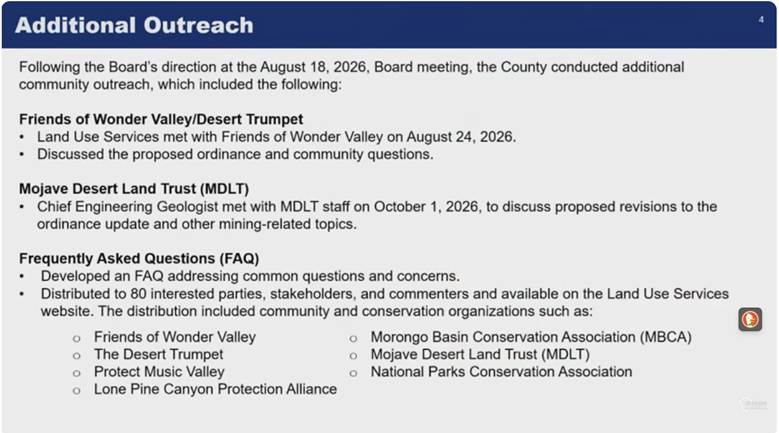
During the LUS presentation at the hearing, LUS Director Miguel Figueroa displayed this slide:
Per the transcript of the hearing, Mr. Figueroa stated, “On August 24th and August 26, Land Use Services staff visited Wonder Valley and 29 Palms to meet with community leaders to hear firsthand their comments and concerns about general issues[emphasis by the speaker] occurring in the area. However, we were also informed about continuous concerns related to this mining ordinance.”
In addition, Mr. Figueroa stated, “Land Use Services conducted public outreach by meeting with community organizations including Friends of Wonder Valley, Desert Trumpet and the Mojave Desert Land Trust to discuss concerns regarding the proposed mining ordinance update, and explain the benefits of the revisions.”
To be clear: Wonder Valley is an unincorporated area of the County and has no official representation as a community or designated community leaders.
First, let us address the “meeting” with Friends of Wonder Valley.
Friends of Wonder Valley is a 501(c)(3) non-profit community services organization. From their website, their Purpose is “to support the Wonder Valley Community, and the Wonder Valley Community Center, through fundraising and programming.” Their Mission: “Friends of Wonder Valley seek to enhance the lives of the people in Wonder Valley by providing programs that engage residents and build community, including arts, music, theater, education, food, health, recreation, and others as need arises and our capacity increases.”
The Friends of Wonder Valley meeting was not about the mining ordinance. It was their regular monthly meeting, and on Aug 4, weeks before the instruction from the Supervisors at the Aug 18 hearing, that meeting was promoted thusly:
We are happy to welcome the members of San Bernardino County Land Use Services (LUS) Executive Leadership team:
Miguel Figueroa, Director of Land Use Services
Thomas Bustamonte, Assistant Director
Maged Soliman, Building Official
Ignacio Nunez, Code Enforcement Chief
Kevin Marstall, Land Development Chief
Paul Gonzales, Planning Chief
Amelia Maldonado, Communications Analyst
They will present, take questions, and provide answers. LUS issues that may be addressed concern dark skies, dump sites, development, and mining.
One other item on the agenda addresses whether or not to have SBC Behavioral Health present to the community in September, and on which topic.
Everyone is welcome to attend and participate.
The LUS team announced at the outset that they had only 45 minutes for the meeting, during which brief time the seven officials each introduced themselves and their departments and, in the minutes remaining, took a few questions. Most of those questions regarded code enforcement, a perennial concern for local residents. There was no presentation on the mining ordinance whatsoever, no discussion of the proposed ordinance or explanation of its benefits, and no realistic time to have any dialogue on that complex subject. The meeting had not been advertised as an opportunity to discuss or learn about the ordinance.
As one Wonder Valley resident commented at the Board of Supervisors meeting after hearing Mr. Figueroa’s claim,
I was frankly shocked a few minutes ago to hear Land Use Services talk about a meeting with friends of Wonder Valley as part of the outreach effort around this ordinance. I am part of that group. I was at that meeting. That meeting was not about this ordinance. We were advised to raise other issues whether it had to do with dumping and other areas of concern. So, I’m not quite sure why you are misinforming the board of supervisors and this entire group on the purpose for that meeting.
Second, regarding the “meeting” with the Desert Trumpet:
The Desert Trumpet is a news organization based in the Morongo Basin. From their website: “The Desert Trumpet is a local news publication which seeks to increase political engagement and encourage a participatory political process by reporting on city government. Our focus is on Twentynine Palms and Yucca Valley as well as Joshua Tree and other unincorporated areas of the Morongo Basin. Our goal is to report on social justice, equity and environmental issues throughout the Morongo Basin, as well as provide a forum for residents to interact on these issues. The Desert Trumpet is published by Morongo Basin Projects, a 501c3 charitable organization.”
In their report on the Oct 20 hearing, the Desert Trumpet stated the following:
As for Figueroa’s reference to the Desert Trumpet, we reviewed our transcript of the conversation. He is referring to our August 26 interview with him in Twentynine Palms, which also included Planning Chief Paul Gonzales, Communications Analyst Amelia Maldonado and City Manager Kevin Cole, and was published September 14 as ‘The New Team At San Bernardino County Land Use Services.’ The mining ordinance came up twice, both times as an example of the difficulty of noticing a countywide item. Its content was not discussed, and no one from the department asked for our views on it. [Emphasis added.]
Third, regarding the meeting with Mojave Desert Land Trust:
Mojave Desert Land Trust is 501(c)(3) organization. From their website, “The Mojave Desert Land Trust has cultivated a multi-faceted conservation strategy that uses land acquisition, restoration, stewardship, plant cultivation, and education to ensure the long-term preservation of the California desert.”
While we respect the work that MDLT does, MDLT is not a spokesperson for, nor does it represent Wonder Valley or the Morongo Basin, when speaking with San Bernardino County representatives, such as Land Use Services.
Additionally, Protect Music Valley reached out to Mr. Figueroa and LUS twice, on Sept 9 and Sept 27, requesting to engage with LUS, as the Board of Supervisors had instructed LUS. NO response was ever received from Mr. Figueroa or Land Use Services other than the amended revision and FAQ document that were released to all interested parties on Sept 29.
Consequently, there was no engagement with concerned and interested community members, and many community members still had unanswered questions about the mining ordinance when it returned to the Board of Supervisors on Oct 20.
Conclusion
The public engagement that the Board of Supervisors instructed Land Use Services staff to conduct did not happen. Concerned community members reached out directly to LUS but were not given the courtesy of a reply – much less actual engagement with the public to answer our many questions. The public was, once again, left out of the process of developing county policy that the public must then live with.
Against the community’s express wishes, on October 20, 2026, the San Bernardino County Board of Supervisors approved the amended mining ordinance. We will have more details soon.
Thanks to all of you who submitted your comments to the Board of Supervisors via this website or by other means.
We will keep you up-to-date with developments as our efforts to Protect Music Valley move forward. If you haven’t already, please sign up for our mailing list so you can be informed of actions that you may take in the future. Together, we will protect Music Valley!
Tuesday, Oct 20, the San Bernardino County mining ordinance revision goes before the Board of Supervisors for a vote. Have you gotten in your comment? Plan to call in, or be there in person? Find out how to be heard in our Action Alert here, and get those comments in! Thank you!
Protect Music Valley has submitted our comments to the Board. We also last week submitted a more detailed letter to County Land Use Services in response to their release of the amended ordinance revision; view that here.
The Desert Trumpet has published an excellent review and analysis of where everything stands at this moment, including a recap of their coverage to date, what the ordinance does, what the amended “redline” version does and doesn’t change, where the conservation coalition stands now, and more.
Not up to all that? Then just read their helpful “Short Version”:
What’s changed and what hasn’t: At the August 18 hearing, the Board heard more than two hours of opposition before continuing the item. Since then Land Use Services has made three changes to the text, two of them versions of fallback wording proposed by a coalition of conservation organizations, and released a frequently asked questions (FAQ) document.
The sentence that drew most of the objections, that a County permit “shall not be required” for mines on federal land with federal approval, is unchanged. The FAQ says the County never had that authority and traces the language to a 1992 state-federal agreement; that agreement does not contain the language and describes authority the County can take on, not authority it lacks.
Where critics stand: Earthworks says it would “like to see stronger language in particular places, but welcome[s] these revisions.” Protect Music Valley says the text is still unclear on CEQA review and asks the Board not to vote until the County holds a public workshop.
Now is the time to take action regarding the county mining ordinance. The language in the ordinance was amended somewhat, but we’re still not comfortable with it. We are asking the Board of Supervisors not to approve any language that would diminish public input on projects like Music Valley. (See our letter to Land Use Services here.)
We also feel that the community, as stakeholders, needed an opportunity to engage with Land Use Services (LUS), as the Board of Supervisors instructed them to do during the August 18th hearing. Instead, LUS sent out a “Frequently Asked Questions” (FAQ) document, and thought that was sufficient. No meetings. No dialog with the public as instructed by the board. No response to the 2 letters that PMV sent to LUS requesting to be included as an interested party.
So, what can you do at this time? Send in your comments!
The ordinance returns to the Board of Supervisors on Tuesday, October 20, 2026. Public comments should be sent in no later than Monday night, 10/19 to be considered in the hearing on Tuesday.
Email the BOS at BoardMeetingComments@cob.sbcounty.gov. Be sure to include the project number that you are commenting on: Re: “Mining Ordinance revision, Project No. PMISC-2026-00029” .
By phone: you can register to comment by phone during the live meeting. Instructions are here.
Show up! Although the county discontinued video commenting from Joshua Tree, you can go to San Bernardino County offices and give your comment in person at the hearing. Meetings are held in the Covington chamber of the County Government Center, 385 North Arrowhead Avenue, First Floor, City of San Bernardino. Register to speak through the kiosks that will be set up in the lobby shortly before the meeting begins.
So, let’s get those comments sent in, and if you can plan to show up – either in person or by phone, on Tuesday, October 20, 2026. The meeting begins at 10:00 am.
On Sept 29, the Department of Land Use Services released an amended version of the San Bernardino County mining ordinance revision. See our response here.
San Bernardino County Land Use Services issued the below email this afternoon in response to letters and comments from the community regarding the proposed revision of the County’s Mining Ordinance (Chapter 88.03). We have posted the attachments that were included, the Final Draft with changes and the Final Mining Ordinance FAQ. We are reviewing the materials and consulting with knowledgeable allies and will provide our take once we have sorted through the still confusing language. In the meantime, thank you everyone who has sent in comments!
Dear Community Members,
Thank you for sharing your comments on the proposed revisions to San Bernardino County’s Mining Ordinance (Chapter 88.03) presented to the Board of Supervisors and considered on August 18, 2026.
We appreciate the questions and concerns raised by the community members and organizations who took the time to share them. We understand some of the proposed changes, especially those related to mining operations on federal lands, have raised questions about the County’s permitting authority, opportunities for public input, environmental review, and local oversight. The County recognizes the importance of addressing these issues clearly and providing more opportunities for public understanding and feedback.
The Board of Supervisors continued the item from August 18 to the October 20, 2026 Board meeting for reconsideration. Ahead of that hearing, the Land Use Services Department, together with the County’s legal staff, has reviewed all comments and prepared the attached Frequently Asked Questions as a public outreach document to provide further clarification.
We have attached the draft ordinance for your review as well. All proposed changes are shown in red to clearly identify proposed revisions to the ordinance. The proposed revisions are intended to take into consideration the feedback and suggestions received from community members and organizations, including the comments shared by those in attendance during the public hearing portion of the August 18 Board meeting.
We encourage you to review these materials and share any additional questions or comments. Feedback may be sent tominingreclamation@lus.sbcounty.gov. Any comments submitted before the hearing will also be added to the public record for the Board’s consideration.
Our goal is to ensure residents, community organizations, and other stakeholders have the information they need to understand the proposed revisions and continue participating in the public process before the item returns to the Board.
Thank you again for your continued interest and involvement.
The most important front right now in the campaign to stop the Music Valley mine is the revision of the County mining ordinance. The revision proposal contains confusing language that could open the gate to projects like the Music Valley mine, and we want the County to delete or change that language. How can you help? We’ve created a letter that you can click-and-send, asking County Land Use Services for two things:
Change that language.
Include the community in the process, as they were directed to by the Board of Supervisors at the hearing on August 18.
We invite you to send in that letter as soon as possible, as we need Land Use Services to feel the pressure to respond.
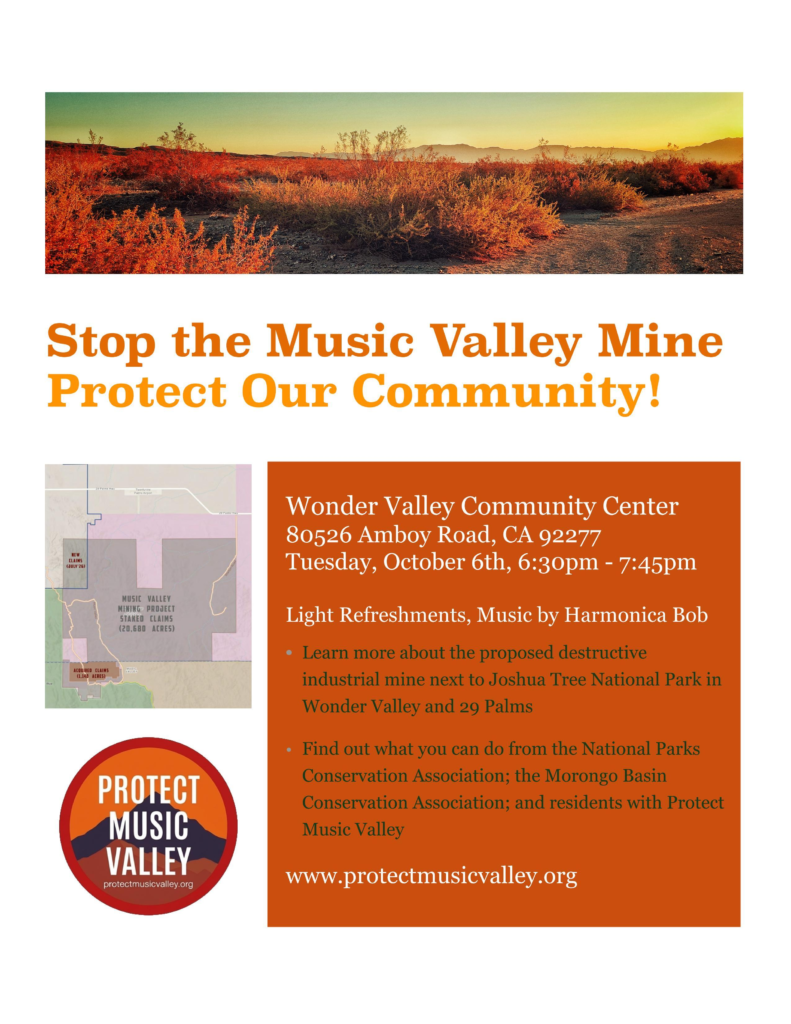
It’s official! Protect Music Valley will host a community informational meeting about the Music Valley Mine on Tuesday Oct 6 at the Wonder Valley Community Center. Attendees will learn more about the proposed destructive industrial-scale mine next to Joshua Tree National Park, in Wonder Valley and 29 Palms. Find out what you can do from the National Parks Conservation Association, the Morongo Basin Conservation Association, and residents with Protect Music Valley. Light refreshments, and music by Harmonica Bob! All welcome. Help spread the word with a printable flyer. Tuesday Oct 6, 6:30-7:45 pm. Wonder Valley Community Center, 80526 Amboy Road.